组合模式的定义与特点
组合(Composite)模式的定义:有时又叫作部分-整体模式,它是一种将对象组合成树状的层次结构的模式,用来表示“部分-整体”的关系,使用户对单个对象和组合对象具有一致的访问性。在软件开发中如:文件系统中的文件与文件夹、窗体程序中的简单控件与容器控件等。组合模式的主要优点有:
- 组合模式使得客户端代码可以一致地处理单个对象和组合对象,无须关心自己处理的是单个对象,还是组合对象,这简化了客户端代码;
- 更容易在组合体内加入新的对象,客户端不会因为加入了新的对象而更改源代码,满足“开闭原则”;
其主要缺点是:
- 设计较复杂,客户端需要花更多时间理清类之间的层次关系;
- 不容易限制容器中的构件;
- 不容易用继承的方法来增加构件的新功能
结构与实现
结构
组合模式包含以下主要角色。
- 抽象构件(Component)角色:它的主要作用是为树叶构件和树枝构件声明公共接口,并实现它们的默认行为。在透明式的组合模式中抽象构件还声明访问和管理子类的接口;在安全式的组合模式中不声明访问和管理子类的接口,管理工作由树枝构件完成。
- 树叶构件(Leaf)角色:是组合中的叶节点对象,它没有子节点,用于实现抽象构件角色中 声明的公共接口。
- 树枝构件(Composite)角色:是组合中的分支节点对象,它有子节点。它实现了抽象构件角色中声明的接口,它的主要作用是存储和管理子部件,通常包含 Add()、Remove()、GetChild()等方法。
透明式组合模式
在该方式中,由于抽象构件声明了所有子类中的全部方法,所以客户端无须区别树叶对象和树枝对象,对客户端来说是透明的。但其缺点是:树叶构件本来没有 Add()、Remove() 及 GetChild() 方法,却要实现它们(空实现或抛异常),这样会带来一些安全性问题。安全组合模式
在该方式中,将管理子构件的方法移到树枝构件中,抽象构件和树叶构件没有对子对象的管理方法,这样就避免了上一种方式的安全性问题,但由于叶子和分支有不同的接口,客户端在调用时要知道树叶对象和树枝对象的存在,所以失去了透明性。
实现
假如要访问集合 c0={leaf1,{leaf2,leaf3}} 中的元素,其对应的树状图如下图所示:
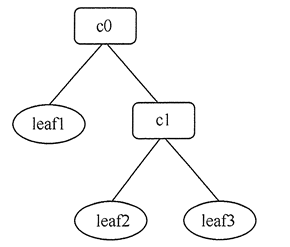
透明式组合模式代码:
package Design_Pattern.composite;

import java.util.ArrayList;

/**
 * @author peng
 * @date 20-5-13 上午10:24
 */
public class CompositePattern {
    public static void main(String[] args) {
        Component c0 = new Composite();
        Component c1 = new Composite();
        Component leaf1=new Leaf("1");
        Component leaf2=new Leaf("2");
        Component leaf3=new Leaf("3");
        c0.add(leaf1);
        c0.add(c1);
        c1.add(leaf2);
        c1.add(leaf3);
        c0.operation();
    }
}
//抽象构件
interface Component{
    public void add(Component c);
    public void remove(Component c);
    public Component getChild(int i);
    public void operation();
}
//树叶构件
class Leaf implements Component{
    private String name;
    public Leaf(String name){
        this.name = name;
    }
    public void add(Component c) {

    }
    public void remove(Component c){}
    public Component getChild(int i){
        return null;
    }
    public void operation(){
        System.out.println("树叶" + name + ":被访问!");
    }
}
//树枝构件
class Composite implements Component{
    private ArrayList children = new ArrayList();
    public void add(Component c){
        children.add(c);
    }
    public void remove(Component c)
    {
        children.remove(c);
    }
    public Component getChild(int i)
    {
        return children.get(i);
    }
    public void operation(){
        for(Object obj:children)
        {
            ((Component)obj).operation();
        }
    }
}
/**
树叶1:被访问!
树叶2:被访问!
树叶3:被访问!
*/
应用实例
用组合模式实现当用户在商店购物后,显示其所选商品信息,并计算所选商品总价的功能。
说明:假如李先生到韶关“天街e角”生活用品店购物,用 1 个红色小袋子装了 2 包婺源特产(单价 7.9 元)、1 张婺源地图(单价 9.9 元);用 1 个白色小袋子装了 2 包韶关香藉(单价 68 元)和 3 包韶关红茶(单价 180 元);用 1 个中袋子装了前面的红色小袋子和 1 个景德镇瓷器(单价 380 元);用 1 个大袋子装了前面的中袋子、白色小袋子和 1 双李宁牌运动鞋(单价 198 元)。
//抽象构件:物品
interface Articles
{
    public float calculation(); //计算
    public void show();
}
//树叶构件:商品
class Goods implements Articles
{
    private String name;     //名字
    private int quantity;    //数量
    private float unitPrice; //单价
    public Goods(String name,int quantity,float unitPrice)
    {
        this.name=name;
        this.quantity=quantity;
        this.unitPrice=unitPrice;
    }
    public float calculation()
    {
        return quantity*unitPrice;
    }
    public void show()
    {
        System.out.println(name+"(数量:"+quantity+",单价:"+unitPrice+"元)");
    }
}
//树枝构件:袋子
class Bags implements Articles
{
    private String name;     //名字
    private ArrayList bags=new ArrayList();
    public Bags(String name)
    {
        this.name=name;
    }
    public void add(Articles c)
    {
        bags.add(c);
    }
    public void remove(Articles c)
    {
        bags.remove(c);
    }
    public Articles getChild(int i)
    {
        return bags.get(i);
    }
    public float calculation()
    {
        float s=0;
        for(Object obj:bags)
        {
            s+=((Articles)obj).calculation();
        }
        return s;
    }
    public void show()
    {
        for(Object obj:bags)
        {
            ((Articles)obj).show();
        }
    }
}
应用场景
- 在需要表示一个对象整体与部分的层次结构的场合。
- 要求对用户隐藏组合对象与单个对象的不同,用户可以用统一的接口使用组合结构中的所有对象的场合。